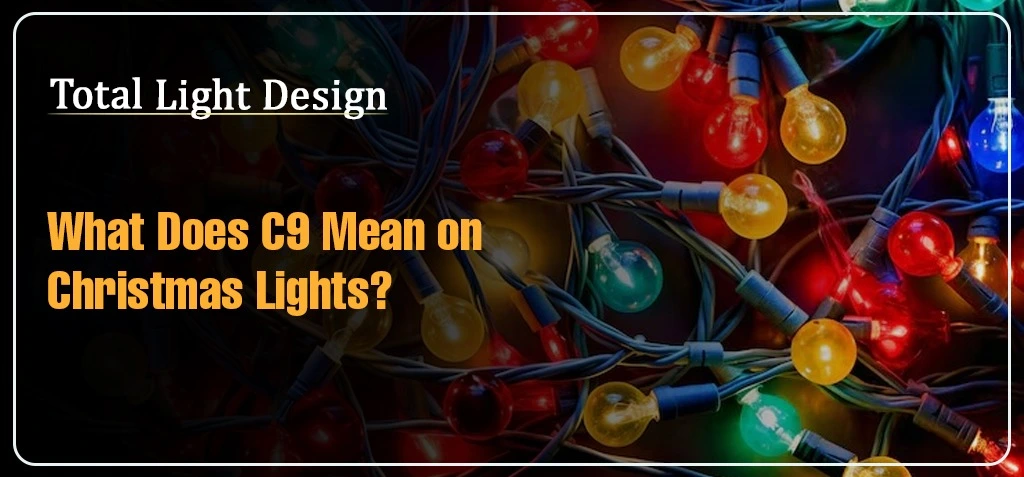
You've finally decided to go all out this holiday season. You're browsing lights online, and suddenly you're buried in codes — C6, C7, C9, E17, LED, incandescent. Sound familiar? If you're planning a professional christmas lights installation washington homeowners and businesses trust to make their homes shine, understanding the basics — starting with what "C9" actually means — is the smartest place to begin. At Total Light Design, we believe an informed homeowner makes for the most stunning holiday display on the block.
So let's break it all down, one glowing bulb at a time.
The "C" Code — What Does It Actually Stand For?
The letter "C" in C9 stands for candle (sometimes called cone). It describes the classic shape of the bulb — that tapered, flame-like silhouette you've seen on rooflines and wrapped around large trees for decades.
The number that follows tells you the bulb's diameter, measured in eighths of an inch. So C9 = Candle shape + 9/8 inches in diameter = 1.125 inches wide. That's the full formula. Simple once you know it.
Here's how the main sizes compare:
- C6 — 6/8 inch (0.75 in) — small, strawberry-oval shape, great for indoor trees.
- C7 — 7/8 inch (0.875 in) — medium, strawberry shape, ideal for windows and smaller trees.
- C9 — 9/8 inch (1.125 in) — large, classic cone, the go-to for rooflines and large outdoor trees.
What Exactly Is a C9 Christmas Light Bulb?
A C9 bulb is the largest traditional Christmas light bulb in widespread use. It sits roughly 2 inches tall and is wide enough to be clearly visible from across the street.
C9 bulbs use an E17 threaded base — a medium intermediate base that screws into E17 sockets on a separate wire cord. This is important: C9 is a bulb-and-socket system, not a pre-wired string light. You buy the socket wire separately and screw in the bulbs yourself (or have a professional do it, which is always the smarter call).
This modularity is actually one of the biggest advantages of C9s. If a single bulb burns out, you unscrew and replace just that one — no tossing an entire strand.
C9 vs. C7: What's the Real Difference?
This is one of the most common questions homeowners ask when planning their holiday lighting. Here's a clear side-by-side breakdown:
| Feature | C7 | C9 |
|---|---|---|
| Bulb Diameter | 7/8 inch | 9/8 inch (1.125 in) |
| Bulb Height | ~1.5 inches | ~2 inches |
| Base Type | E12 (nightlight base) | E17 (intermediate base) |
| Incandescent Wattage | 5W | 7W (10W clear available) |
| LED Wattage | ~0.5–0.9W | ~0.84–1.5W |
| Best Use | Windows, doors, smaller trees | Rooflines, ridgelines, large outdoor trees |
| Visibility from Street | Good | Excellent |
Quick tip: If a C7 bulb fits in your nightlight socket at home, you're looking at an E12 base. C9 bulbs are noticeably bigger — they won't fit a nightlight.
Why C9 Bulbs Dominate Professional Installations
Walk past any professionally decorated home during the holidays and you'll almost certainly be seeing C9 bulbs on the roofline. There's a reason for that.
C9 bulbs offer the best street presence. At nearly 2 inches tall and over an inch wide, they're bold enough to define the entire architectural silhouette of a home — the roofline, ridge, gable ends, eaves, and fascia — in a way smaller bulbs simply can't match.
They're the professional's choice for large-scale displays.
Here's why installers prefer them:
- Brightness — Even in LED form, C9s produce a strong, punchy glow that reads beautifully at night.
- Durability — Their larger size means thicker glass and more robust construction compared to smaller bulbs.
- Replaceability — Individual bulbs screw in and out, making maintenance simple.
- LED efficiency — Modern LED C9s draw less than 1 watt per bulb, a massive saving over the old 7W incandescent versions.
- Versatility — Available in dozens of colors, finishes (faceted, smooth, frosted), and effects (twinkle, strobe, steady).
C9 LED vs. C9 Incandescent — Which Should You Choose?
This question comes up constantly, and the answer has shifted dramatically in the last few years.
Incandescent C9s give off that warm, slightly golden glow many people associate with childhood Christmases. They're nostalgic, beautiful, and inexpensive upfront. But they consume 7–10 watts each, run hotter, and have a shorter lifespan.
LED C9s have come a long way. Modern LED versions — especially warm white variants — now closely replicate the incandescent look while drawing under 1 watt per bulb. They last far longer, run cooler (reducing fire risk), and cost far less to operate over a season.
If you're decorating a full roofline with 100 C9 bulbs:
- Incandescent: 100 × 7W = 700 watts per hour
- LED: 100 × 0.84W = 84 watts per hour
That's a massive difference on your electricity bill over an entire holiday season.
Our recommendation at Total Light Design: Go LED. The upfront cost is slightly higher, but the energy savings and lifespan more than make up for it — especially if you plan to use your display year after year.
Best Places to Use C9 Christmas Lights
C9 bulbs aren't the right choice for every location — but for the right spots, nothing beats them.
Best applications for C9 lights:
- Rooflines and ridge lines — This is where C9s reign. Their size and brightness define the outline of your home perfectly.
- Gable ends and eaves — Frame the architectural features of your home for a polished, professional look.
- Large outdoor trees — Wrap trunks and major branches for that bold, luminous outdoor-tree glow.
- Fence lines and garden borders — Add a dramatic holiday border along driveways or property lines.
- Commercial storefronts — C9s are widely used in commercial districts for their visibility and festive impact.
Where NOT to use C9 lights:
- Small indoor tabletop trees (C6 or mini lights work better here).
- Delicate wreaths or garlands (C7 is more proportionate).
- Tight or enclosed spaces where bulb heat could be a concern (use LED C9s if you need them in enclosed areas).
How Many C9 Bulbs Do You Need?
Planning your display starts with a quick measurement. Here are general guidelines:
- Rooflines: Place C9 bulbs 12 inches apart for a full, even look; 18 inches apart for a more subtle outline.
- Large trees: Estimate roughly 100 bulbs per foot of tree height for full coverage.
- Fence lines: One bulb every 12–18 inches depending on the look you want.
A standard 25-foot roofline with bulbs spaced 12 inches apart needs about 25 C9 bulbs — plus the socket wire. Going corner-to-corner on a full home, you could easily need 150–300 bulbs.
This is exactly the kind of calculation a professional installer handles for you — measuring, planning, sourcing, and installing everything so you don't have to climb a ladder in December.
C9 Bulb Colors and Finishes — Your Options
C9 bulbs come in far more variety than most homeowners realize. Here's what's available:
Color options:
- Classic warm white (most popular for a timeless look).
- Pure/cool white (crisp, modern, snow-like effect).
- Multi-color (red, green, blue, yellow, orange — festive and vibrant).
- Single color (red, blue, green, etc. — great for themed displays).
Finish options:
- Smooth/transparent — Maximum light output, classic look.
- Frosted/opaque — Softer, diffused glow.
- Faceted — Prismatic surface that sparkles and scatters light beautifully.
Effect options (LED only):
- Steady on.
- Twinkle/fade.
- Strobe.
Tips for Installing C9 Lights the Right Way
Whether you're doing this yourself or hiring a professional, these tips will save you headaches:
- Always buy more than you think you need. It's better to have extra bulbs than to run short mid-roofline.
- Match your socket wire color to your roofline. White wire for white trim, green for dark trim — it nearly disappears in daylight.
- Don't exceed your strand limits. Check the manufacturer's guidelines for how many strands can be connected end-to-end.
- Use outdoor-rated clips and staples. Never use standard staples that can pierce the wire and create a safety hazard.
- Inspect bulbs before hanging. Check for cracks, loose bases, or signs of damage.
- Consider a timer or smart plug. Automating your lights saves energy and ensures they're never left on accidentally overnight.
And if any of this sounds like too much to manage — that's what professional installation services exist for.
Why Work With a Professional Christmas Lights Installer?
There's a version of holiday decorating where you spend four cold weekends on a ladder, untangling wires and guessing at spacing. And there's a version where it all just appears — perfectly spaced, beautifully designed, safely installed — and disappears just as smoothly after the holidays.
Total Light Design offers the second version.
Working with a professional team means:
- Accurate measurement and custom design tailored to your home's architecture.
- Safe, secure installation using the right hardware and techniques.
- High-quality commercial-grade bulbs and wiring (not the flimsy big-box store variety).
- Take-down and storage included, so your lights are ready to go again next year.
- No ladders, no guesswork, no wasted weekends.
Your home deserves a display that matches the effort — not a compromise.
Final Thoughts: Small Code, Big Impact
The "C9" label is short, but knowing what it means unlocks smarter decisions for your entire holiday display. These are the big, bold, beautiful workhorses of professional holiday lighting — and when installed well, they transform a home into something that stops traffic.
Whether you're researching C9 bulbs to buy and install yourself, or you're ready to hand the whole project over to the experts, the most important thing is starting with the right information.
Ready to light up your home this holiday season? Get in touch with Total Light Design to schedule a consultation and see what a professional installation looks like from the first bulb to the last.
Total Light Design — Professional Holiday Lighting Installation. Designed beautifully. Installed safely. Remembered forever.